Falling behind on rent in Florida can happen faster than most people expect. A missed paycheck, a medical bill, a sudden job loss — any one of these can push a household from stable to at risk of eviction within a matter of weeks. If you are in that situation right now, emergency rental assistance programs in Florida exist specifically to help. This guide covers everything you need to know about emergency rental assistance eligibility in Florida: which programs are available, exactly who qualifies, what documentation you need, and how to apply so you get help before your landlord files for eviction.
If you are also dealing with food insecurity or healthcare costs alongside your housing situation, our complete guide to all benefits available to low-income Floridians covers every program you may be eligible for in one place.
Quick Navigation
- Overview of Emergency Rental Assistance in Florida
- Main Programs Available in 2026
- Who Qualifies: Core Eligibility Requirements
- Income Limits Explained
- What Emergency Rental Assistance Covers
- Documents You Will Need
- How to Apply Step by Step
- What If Eviction Proceedings Have Already Started?
- Tips to Improve Your Chances of Approval
- Frequently Asked Questions
Overview of Emergency Rental Assistance in Florida
Emergency rental assistance in Florida is not a single program with one application — it is a patchwork of federal, state, and locally administered funds, each with its own income limits, priority groups, and application process. Understanding this upfront will save you a lot of confusion and help you apply to the right programs quickly.
At the federal level, Congress has funded multiple rounds of Emergency Rental Assistance (ERA) since 2021. Florida received billions in ERA funding, which was distributed to counties and municipalities to administer locally. Many of those federal funds have been spent down, but several counties and local agencies continue to operate ERA programs using remaining balances or state-appropriated replacements. On top of that, Florida’s State Housing Initiatives Partnership (SHIP) program, local Community Action Agencies, and various nonprofit organizations maintain their own rental assistance funds that operate independently of federal ERA dollars.
The bottom line is that help exists — the key is knowing where to look and how to apply correctly the first time.
Main Emergency Rental Assistance Programs in Florida in 2026
Local County ERA Programs
Each county in Florida manages its own emergency rental assistance program funded through a combination of federal ERA dollars and state grants. The largest counties — Miami-Dade, Broward, Palm Beach, Hillsborough, Orange, and Duval — have dedicated housing assistance offices that process applications. Smaller counties typically contract with a local Community Action Agency or nonprofit to manage the funds. Availability and benefit amounts vary significantly by county, so your first step is always to identify your county’s specific program.
Florida SHIP Program
The State Housing Initiatives Partnership (SHIP) program is one of Florida’s most important tools for housing stability. SHIP allocates funds to all 67 counties specifically for rental assistance, down payment help, home repair, and related housing needs. Each county administers SHIP independently, which means eligibility requirements and the types of assistance available will differ depending on where you live. Contact your county’s SHIP administrator directly to find out what rental assistance funds are currently available and whether applications are open.
Florida Housing Finance Corporation (FHFC) Programs
The Florida Housing Finance Corporation oversees several statewide housing programs that include a rental assistance component. FHFC works with property managers of affordable housing communities to ensure renters in those developments have access to stability resources. If you live in an FHFC-assisted property, speak with your property manager about what assistance may be available through your building’s administration.
Community Action Agency Emergency Funds
Community Action Agencies (CAAs) operate in every region of Florida and often maintain emergency rental assistance funds funded through a mix of federal Community Services Block Grant (CSBG) money, local government contracts, and private donations. CAAs can sometimes move faster than government programs and may have eligibility thresholds that differ from ERA programs. Call 211 to be connected with your local CAA.
Nonprofit and Faith-Based Emergency Assistance
Organizations including Catholic Charities, the Salvation Army, Jewish Family Services, and St. Vincent de Paul Society operate emergency rental assistance funds across Florida. These tend to be smaller amounts — often one month’s rent — but they can serve as a bridge while you wait for a larger government program to process your application. Dial 211 to find out which organizations in your zip code currently have funds available.
Who Qualifies: Core Eligibility Requirements
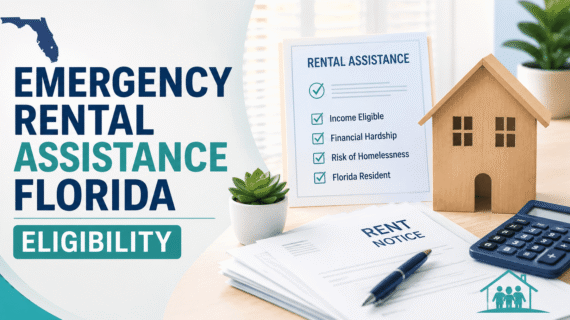
While each program has specific rules, most emergency rental assistance programs in Florida share a common set of core eligibility criteria. To qualify for most programs, you will generally need to meet all of the following:
- You are a renter. You must be renting your current residence — homeowners are not eligible for rental assistance, though separate home repair and mortgage assistance programs exist.
- You rent in Florida. The property must be your primary residence located within the state of Florida, and typically within the specific county or service area of the program you are applying to.
- You are experiencing financial hardship. This means your inability to pay rent is due to a documented financial hardship — such as a job loss, reduction in hours, medical emergency, or other qualifying crisis. Most programs ask you to describe this hardship in writing.
- You are at risk of housing instability. You must demonstrate that failing to receive assistance would result in eviction, homelessness, or unsafe living conditions. A past-due rent notice, eviction notice, or landlord statement confirming arrears is typically required.
- Your income falls within program limits. Household income must be within the program’s income threshold — usually between 50% and 80% of the Area Median Income (AMI) for your county.
- You are a U.S. citizen or qualified immigrant. Most federal ERA programs require citizenship or qualified immigration status, though some local nonprofit programs do not have this requirement.
Priority is typically given to households that include very low-income earners (below 50% AMI), households with children, seniors age 62 or older, and those who have already received an eviction notice. If you recently lost your job, documenting that unemployment is a key part of demonstrating hardship — our guide to Florida benefits for unemployed residents outlines what additional support may also be available to you.
Income Limits for Emergency Rental Assistance in Florida
Income eligibility for most Florida emergency rental assistance programs is measured as a percentage of the Area Median Income (AMI), which varies by county and household size. Unlike federal poverty guidelines, AMI is updated annually and reflects actual housing market conditions in each area. Here is a general framework of how income thresholds typically break down:
| Income Category | % of AMI | Priority Level |
|---|---|---|
| Extremely Low Income | 30% AMI or below | Highest priority |
| Very Low Income | 31%–50% AMI | High priority |
| Low Income | 51%–80% AMI | Standard eligibility |
| Moderate Income | 81%–120% AMI | Limited programs only |
To give a concrete example: in Orange County (Orlando area), 80% AMI for a family of four is approximately $72,800 annually as of 2026. In Miami-Dade, the same threshold is around $76,400. Because AMI varies by county, always verify the exact income limit with your local program before assuming you do or don’t qualify.
If your income is just above the rental assistance threshold, you may still qualify for other forms of financial relief. Florida’s cash assistance program, for instance, uses different income cutoffs. Our guide to Florida cash assistance and how to apply explains how that program works and whether it might help bridge the gap.
What Emergency Rental Assistance Covers
Most Florida emergency rental assistance programs cover more than just your current month’s rent. Depending on the specific program and available funding, assistance may include:
- Past-due rent arrears — typically up to 12 months of unpaid rent, sometimes up to 18 months in programs with remaining federal ERA funds
- Current and future rent — up to 3 months of forward rent in some programs, designed to give you a buffer while your financial situation stabilizes
- Utility arrears tied to your rental unit — some ERA programs also cover past-due utility costs like electricity, water, and gas if they are in your name and connected to your rental home
- Late fees — fees charged by your landlord as a result of late rent payments may be included in some programs
- Moving costs or security deposits — a smaller number of programs help households transition to more stable housing if staying in the current unit is not viable
Payments are typically made directly to your landlord, not to you. This means your landlord must agree to participate in the program — which most do, since it guarantees them payment. If your landlord refuses to cooperate, notify your local program coordinator immediately, as some programs have workarounds that allow them to issue payments directly to tenants under specific circumstances.
Documents You Will Need
Having complete documentation ready before you apply is one of the most effective ways to speed up approval. Incomplete applications are the leading cause of delays. Gather the following before you start:
- Government-issued photo ID for all adult household members
- Social Security numbers for all household members
- Proof of income for the past 30 to 60 days — recent pay stubs, SSI or Social Security award letters, unemployment benefit statements, or a self-employment income affidavit
- Current lease agreement showing your name, address, landlord’s name, and monthly rent amount
- Landlord’s contact information — name, mailing address, phone number, and email
- Past-due rent notice or eviction notice — any written documentation from your landlord confirming arrears or initiating eviction proceedings
- Proof of hardship — a termination letter, medical bill, or other documentation explaining why you fell behind on rent
- Bank statements from the past 1 to 3 months, if required by your local program
- Utility bills if you are also requesting assistance with utilities
If you are simultaneously applying for SNAP or other benefits through MyACCESS Florida, many of these same documents will apply. Our guide on documents needed for a Florida benefits application covers the overlap and can help you prepare one complete package for multiple programs at once.
How to Apply for Emergency Rental Assistance in Florida
- Call 211 first. Before searching online, dial 211. Florida’s statewide helpline will identify which rental assistance programs are currently accepting applications in your county, whether funding is still available, and what the current wait times are. This single call can save you hours of dead ends.
- Find your county’s specific program. Search “[your county name] emergency rental assistance” or visit your county government’s official website. Most counties have a Housing or Community Services department with current program details.
- Notify your landlord. Let your landlord know you are applying for emergency rental assistance. Many programs require landlord participation, and giving your landlord advance notice can prevent eviction proceedings from continuing while your application is reviewed.
- Gather all documents from the checklist above before starting your application. Most programs allow you to upload documents digitally — take clear photos with your smartphone if you don’t have a scanner.
- Submit your application and note your case number. Keep a copy of every document you submit and record your case or reference number. You’ll need this to follow up.
- Apply to MyACCESS Florida simultaneously. If you haven’t already, use the MyACCESS Florida portal to apply for SNAP, Medicaid, and TANF benefits at the same time. These programs address food and healthcare needs while rental assistance addresses your housing, and there is no conflict in applying for all of them simultaneously.
- Follow up regularly. Check your application status every few days. Programs often send requests for additional documentation by email, and missing a deadline can result in your application being closed.
What If Eviction Proceedings Have Already Started?
If your landlord has already filed for eviction, do not assume you have missed your window for assistance. Many Florida counties have agreements with local courts to pause eviction proceedings when a verified rental assistance application is pending. Here is what to do immediately:
- Respond to all court documents. Ignoring an eviction filing will result in a default judgment against you. Respond in writing by the deadline shown on your court papers, even if it is just to notify the court that you have a rental assistance application pending.
- Bring your application confirmation to your court date. A case number or confirmation email from your rental assistance application is powerful evidence in court and may convince a judge to grant a continuance while assistance is processed.
- Contact Florida Legal Aid. Free legal assistance for tenants facing eviction is available through Florida Legal Aid and Bay Area Legal Services, among others. Call 211 to be connected with the nearest legal aid office in your area.
- Ask the program to contact your landlord directly. Many programs will reach out to landlords to confirm that payment is forthcoming, which often stops eviction proceedings faster than anything else.
If a job loss triggered your housing crisis, it is also worth exploring whether you qualify for Florida’s unemployment benefits to help stabilize your income going forward. See our guide on Florida benefits for unemployed residents for a full breakdown of what’s available.
Tips to Improve Your Chances of Approval
- Apply as early as possible. Emergency rental assistance funds are capped and distributed on a first-come, first-served basis. Programs frequently run out of money mid-year. Apply the moment you realize you may fall behind — do not wait until you have a court date.
- Be specific about your hardship. Vague statements like “financial difficulty” are less compelling than a specific, documented explanation: a termination letter, a hospital bill, or a statement explaining that your hours were cut by a specific amount.
- Keep communicating with your landlord. A landlord who knows you are actively pursuing assistance and communicating openly is far less likely to continue eviction proceedings than one who hears nothing. Put your communication in writing — text messages and emails create a paper trail.
- Apply to multiple programs simultaneously. There is no rule against applying to your county ERA program, your local CAA, and a nonprofit fund at the same time. The first approval you receive can be reported to the others so they can close their files — but multiple applications increase the speed at which you receive help.
- Ask about TANF if you have children. If you have children under 18 in your household, Florida TANF may be able to provide immediate cash assistance that can serve as a partial rent payment while your rental assistance application is processed. Learn more in our guide to Florida TANF benefits and eligibility.
Frequently Asked Questions
How much rental assistance can I receive in Florida?
The maximum varies by program and county. Most ERA programs cover up to 12 months of past-due rent plus up to 3 months of forward rent, subject to available funding. Some programs cap total assistance at a fixed dollar amount — often between $5,000 and $15,000 per household — while others base the cap on actual arrears. Your local program coordinator can tell you the current maximum for your county.
Can I apply for emergency rental assistance if I am behind just one month?
Yes. You do not need to be multiple months behind to qualify. Being one month past due with a written notice from your landlord is typically sufficient to demonstrate housing instability. Apply early — do not wait until arrears accumulate or an eviction is filed.
Does my landlord have to agree to participate?
For most programs, yes — payment is made directly to the landlord, which requires their cooperation. However, landlords are strongly incentivized to participate since it guarantees them payment of arrears they might otherwise have to pursue through costly court proceedings. If your landlord refuses, notify your local program — some have provisions to issue payment directly to tenants in uncooperative landlord situations.
Will receiving rental assistance affect my SNAP or Medicaid benefits?
Generally, no. Emergency rental assistance payments are not counted as income for purposes of SNAP, Medicaid, or most other federal assistance programs. However, if you are unsure about your specific situation, confirm with the agency that administers each of your current benefits before applying.
What if the rental assistance program in my county has no funding?
Call 211 immediately for referrals to nonprofit and faith-based emergency funds. Additionally, ask your county SHIP coordinator whether any SHIP rental assistance funds are available — SHIP operates on a separate funding stream from ERA and may still have money when county ERA funds are exhausted.
Don’t Wait — Help Is Available Right Now
The biggest mistake tenants make when facing housing instability is waiting too long to ask for help. Emergency rental assistance programs in Florida have real money available for qualifying households — but that money moves fast, waiting lists grow, and eviction timelines are unforgiving.
Start by calling 211 today. Tell them you are behind on rent, you are in Florida, and you need emergency rental assistance. They will connect you with the right programs for your county within minutes. From there, gather your documents, notify your landlord, and submit your application as completely as possible the first time.
And if rent is just one piece of a larger financial crisis you’re working through, our full guide on all benefits available to low-income Floridians will help you identify every program — food, healthcare, utilities, cash assistance, and more — that you may qualify for right now.
Disclaimer: Program availability, income limits, and benefit amounts are subject to change and vary by county. This article reflects information available as of May 2026. Always verify current program details directly with your local administering agency before applying.